Five excellent papers on fermentation regulation in 2025 are all addressing these real issues AI reconstruction, precise fermentation, parameter optimization ..

1. Using AI to reconstruct metabolic flow, the production of penicillin C1a increased by 54%. The low potency and large batch fluctuations of penicillin C1a have been a major challenge for many antibiotic factories.
The East China Institute of Technology team did not follow the old path, but combined artificial neural networks+genetic algorithms (ANN-GA) with online spectroscopy (NIR+Raman) to observe what was happening in the jar in real time.
Through metabolic flux analysis, the carbon flow was accurately redirected from glycolysis to the pentose phosphate pathway. As a result, with an increase in NADPH and sufficient precursors, the potency increased from 249 mg/L to 385 mg/L.
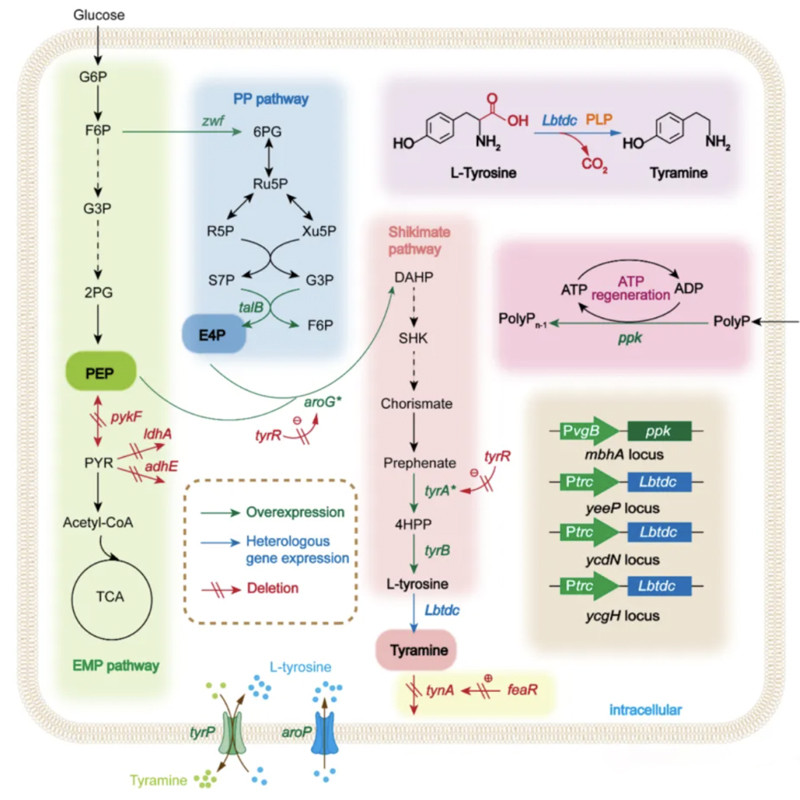
Do you want Escherichia coli to efficiently synthesize casein? Simply modifying genes is not enough, fermentation strategies need to keep up.
The Tianjin University of Science and Technology team's approach is very clever: in the early stage, high dissolved oxygen (30%) bacteria grow vigorously and accumulate tyrosine; In the later stage, it is almost anaerobic (0-5%), forcing cells to convert raw materials into casein.
In addition, knocking out by-product genes and regulating ATP regeneration with anaerobic promoters ultimately achieved a titer of 21.33 g/L, which is already at an industrial level in amine compounds. Key insight: Good strains+good processes=true high yield.
3. Alpha myrrh is the "golden molecule" in the spice industry, but yeast goes on strike as soon as it is mass-produced.
The Beihua team found that high temperatures promote growth but inhibit synthesis. So they played a "temperature switch" - first nourishing the cells at 30 ℃, and then lowering it to 26 ℃ to activate the product pathway.
By strengthening the MVA pathway and optimizing the culture medium, we ultimately achieved a global record of 18.6 g/L in the feeding batch. Sometimes, the simplest physical parameter (such as temperature)
During the fermentation process, knowing who is alive is more important than who exists.
But traditional methods are either slow (plate culture for 2 days) or have high false positives (qPCR even counts dead bacteria).
The Sichuan University team has developed a "one pot method" for rapid detection of live bacteria using Cas13a+Csm6 tandem probes: as long as the target RNA is still present, fluorescence cascade amplification can be triggered.
The result can be obtained in 30 minutes with a sensitivity of 1%, and it is effective for both lactic acid bacteria and Bacillus subtilis.
This may be a crucial step towards online process quality control - after all, fermentation cannot wait.
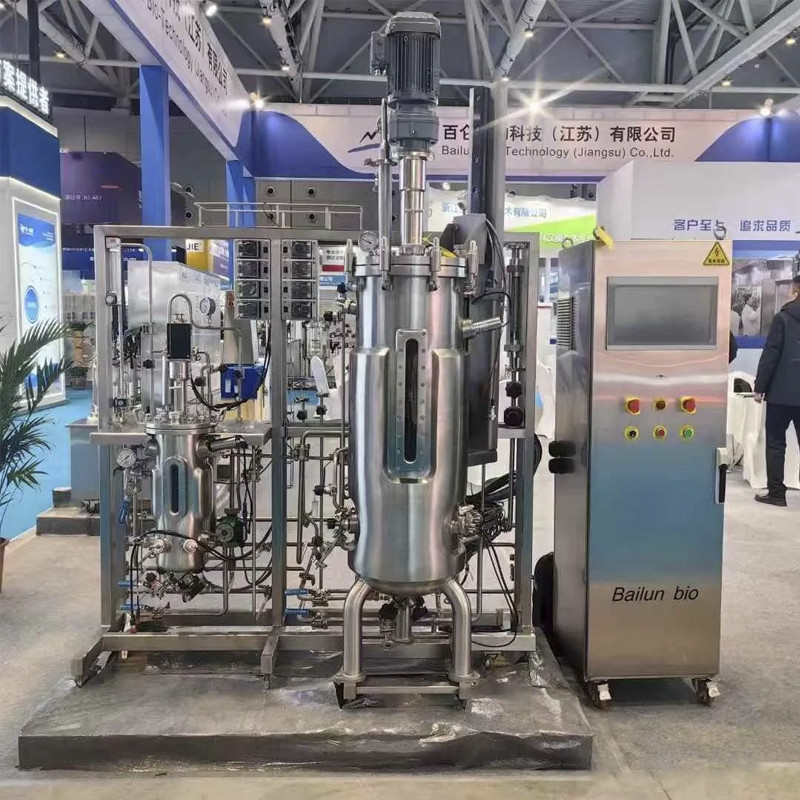
5. Does dopamine easily oxidize and turn black once it enters the fermentation tank? Tianjin University of Science and Technology provides a solution:
Constructing plasmid free stable strains to avoid genetic drift;
In the first stage, bacteria grow at normal pH, and in the second stage, lowering the pH slows down degradation;
Add Fe ² ⁺ and ascorbic acid to "escort" and lock in the product.
Finally, a stable output of 22.58 g/L was achieved in a 5L tank, solving the stubborn problem of "producing but not retaining". For easily oxidizable products, fermentation is not only synthesis, but also protection.
These 5 tasks have one thing in common: they do not conduct experiments for the purpose of publishing papers, but design strategies to solve problems.
Whether it's AI regulation, parameter switching, rapid detection, antioxidant protection, behind it all lies a profound understanding of the "essence of fermentation" - microorganisms are not machines, fermentation is not a fill in the blank question, but a delicate dynamic balance.